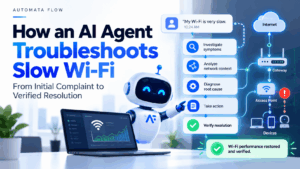
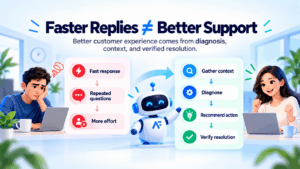
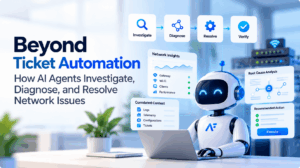
AI agents can resolve selected MSP and ISP support tickets – but not every ticket, and not simply because the agent can execute a command.
Real resolution requires enough evidence to identify the problem, a permitted way to address it, and a check that the customer-facing service works again.
An MSP receives a support ticket from an employee of one of its business customers: “I’m connected to the company VPN, but I can’t access our internal application.” An ISP receives a different complaint: “The router shows Wi-Fi connected, but the internet keeps dropping.” Both sound familiar. Neither description identifies the cause.
Some cases can follow a repeatable path to resolution. Others need an engineer, an upstream provider, or a field visit. The useful question for MSPs and ISPs is which tickets an agent can handle reliably within their own systems and operating rules.
What Does “Resolved” Actually Mean?
A ticket has not necessarily been resolved because it has been categorized, assigned, or marked Closed. Nor is an issue resolved simply because a management API returned a success response.
For a VPN case, success may mean the affected user can reach and use the application. For a broadband case, it may mean the connection is stable again and the original symptoms are no longer observed. The required confirmation should be defined for each issue type; sometimes network telemetry is sufficient, and sometimes customer confirmation is also needed.
That gives us three distinct outcomes: ticket processed, action executed, and service restored and verified. An AI support agent may participate in all three. Only the last supports a claim of technical resolution.
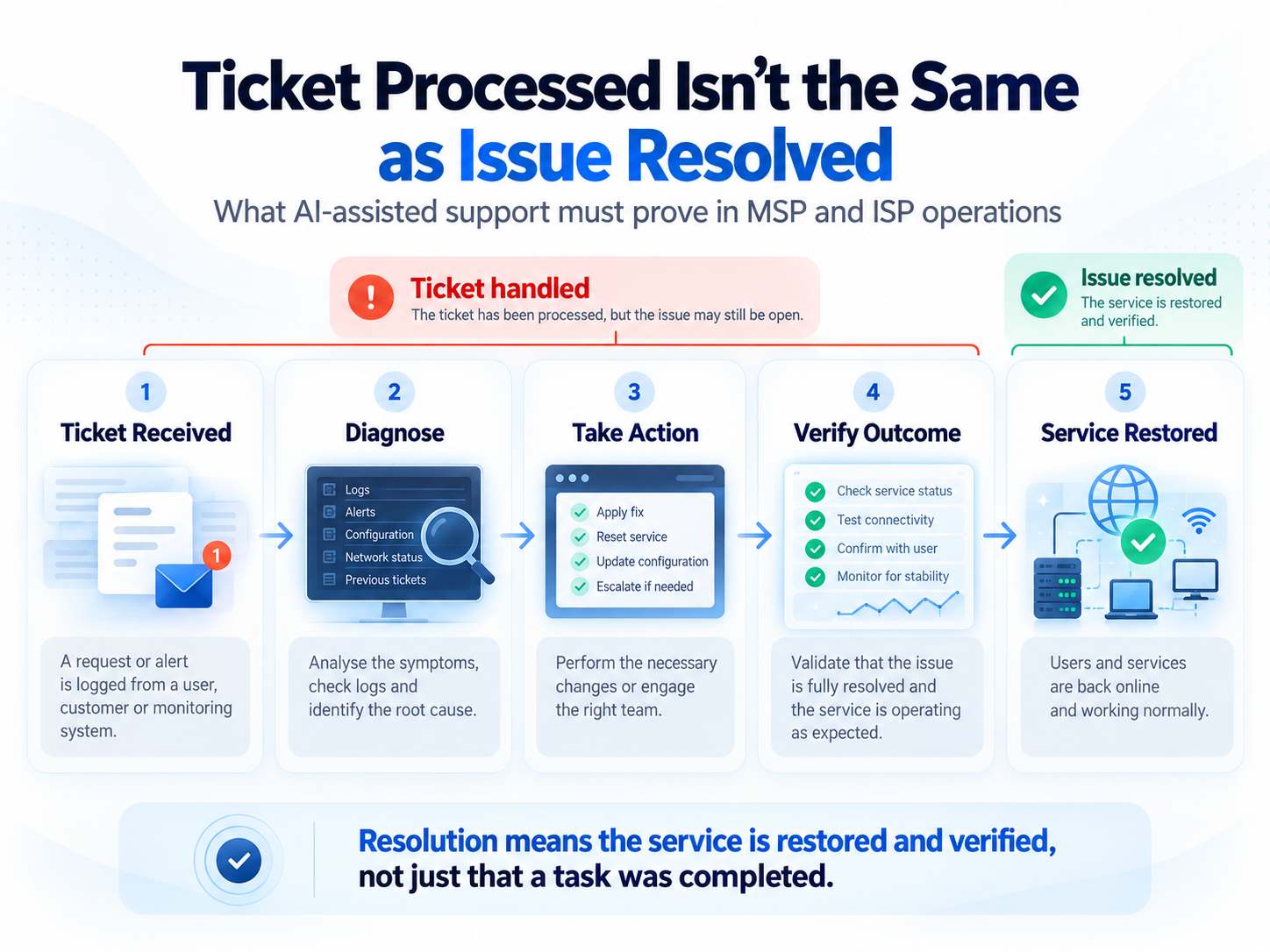
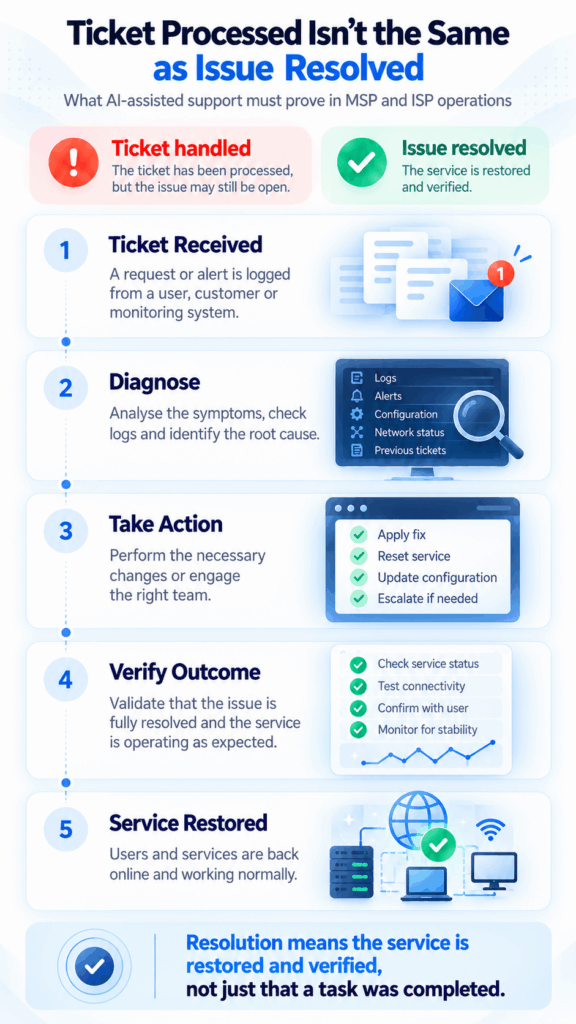
A ticket is only technically resolved when service restoration is verified – not merely when an action completes.
Which MSP and ISP Tickets Can AI Agents Resolve?
There is no reliable universal percentage. Even a familiar issue type can be difficult when device access is missing, customer-specific settings are unknown, or the corrective action would interrupt a shared service.
A practical way to separate tickets is by the level of intervention they require.
Typical ticket | Suitable AI role | Important condition |
Single-user connectivity or name-resolution problem | Investigate; guide an approved user-side fix; verify | Evidence identifies the affected user and likely fault |
Known device or service state problem | Apply a scoped, permitted recovery action; verify | Action is reversible, allowed and has a measurable outcome |
CPE restart or Wi-Fi setting change | Investigate; request approval or use a pre-authorized workflow | Customer impact and device scope are understood |
Shared network outage or ambiguous multi-site failure | Correlate evidence; create or update a wider incident; escalate | A local restart should not hide a service-wide fault |
Physical line fault, hardware replacement or unsafe production change | Collect diagnostics; hand off or dispatch | The agent cannot safely perform the required physical or high-impact work |
The same action may fall into different categories in different environments. Restarting one subscriber’s gateway with their approval is not the same as restarting equipment supporting dozens of customers.
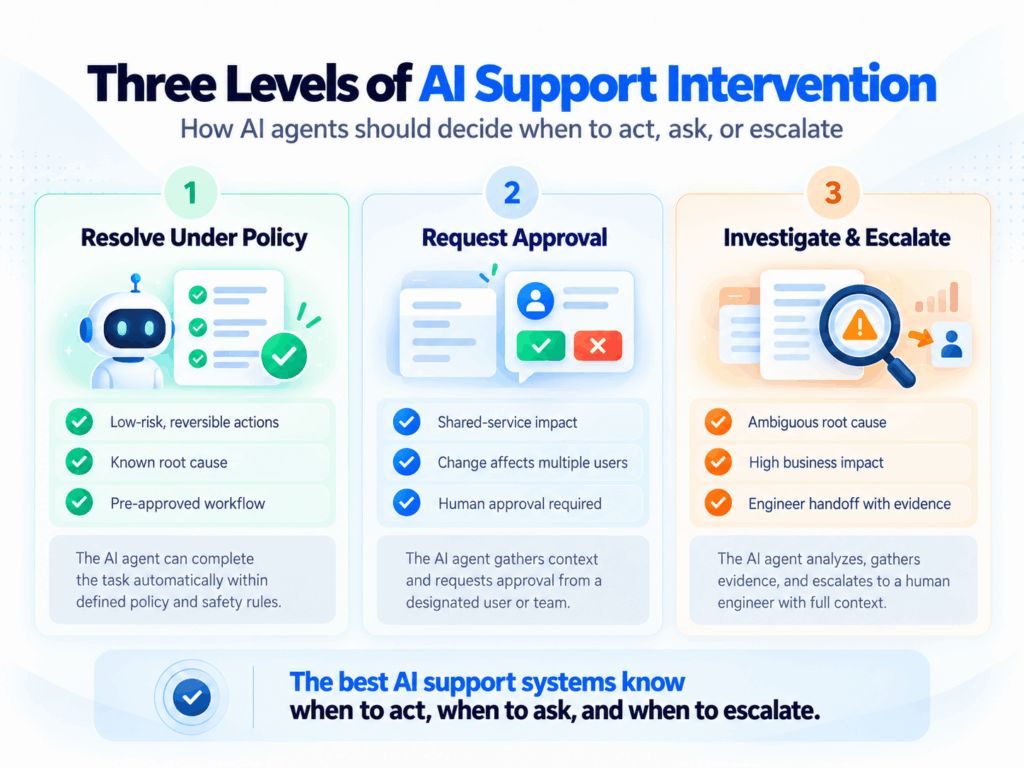
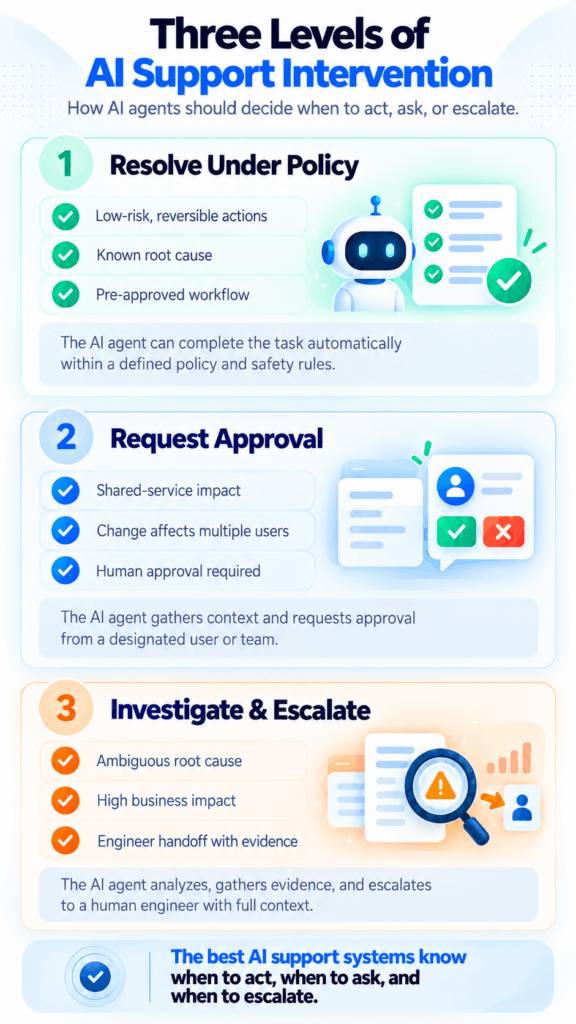
The best AI support systems know when to act, when to ask, and when to escalate
MSP Scenario: VPN Connected, Application Unavailable
Consider an MSP supporting a business with remote staff. One employee can connect to the corporate VPN but cannot reach an internal application. This is an illustrative scenario, not a claim about a particular deployment.
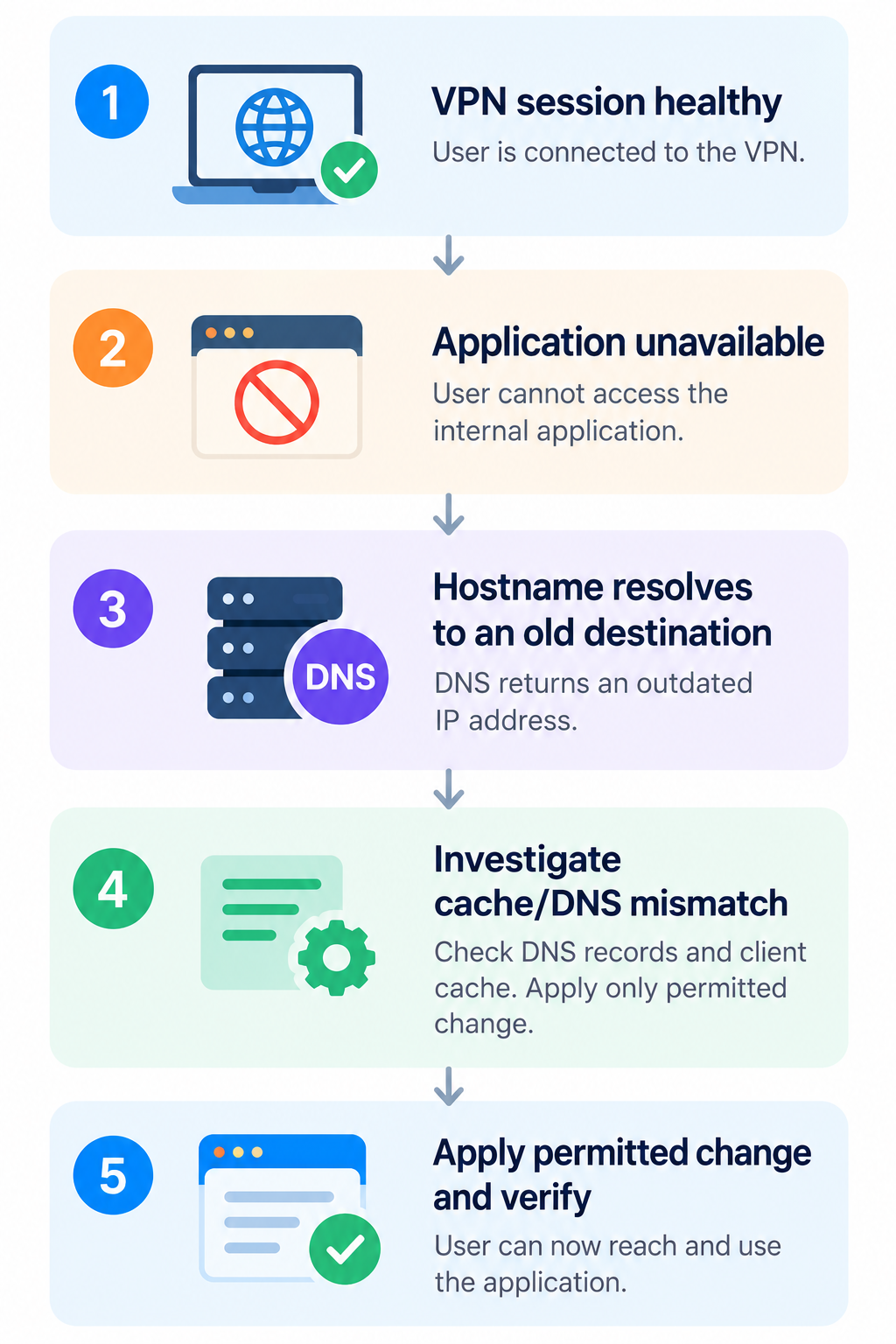
If the MSP has the relevant VPN, DNS, and network integrations, a useful first investigation is narrow: confirm the VPN session is active, identify the intended application, check name resolution, compare the returned destination with an approved change record, and test the network path from a permitted location.
Suppose the VPN session is healthy, but the application hostname still resolves to an old internal address. A recent approved change lists a new destination. The evidence suggests a stale DNS record or cache, although the agent still needs to confirm where the mismatch originates.
There may be a straightforward user-side cache refresh. A shared DNS record change, however, may require a network engineer’s approval because it can affect other users. The agent should distinguish those actions rather than treating both as harmless fixes.
The ticket is resolved only after the affected user can access the application, or the agreed verification policy confirms restoration. Otherwise the incident stays open, with the diagnosis and attempted steps recorded for the engineer.
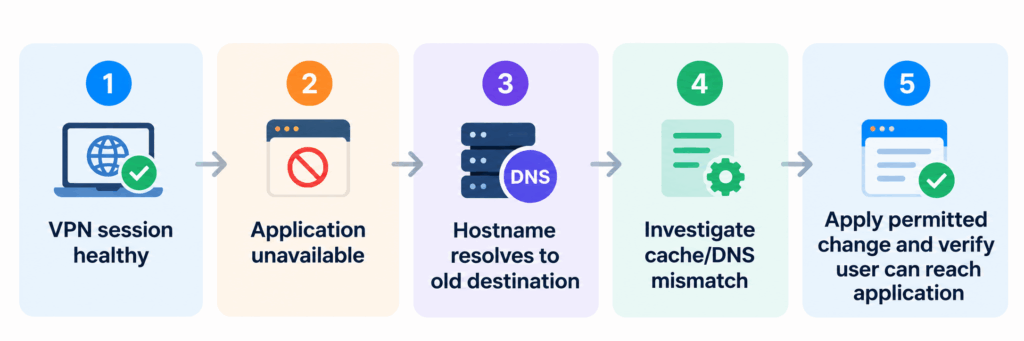
MSP diagnostic pattern
VPN session healthy → application unavailable → hostname resolves to an old destination → investigate cache/DNS mismatch → apply only permitted change → verify that the user can reach the application.
ISP Scenario: Wi-Fi Connected, Internet Intermittently Unavailable
Now consider an ISP subscriber who says, “The Wi-Fi is connected, but websites stop loading several times a day.”
Where the ISP has access to the necessary CPE and monitoring data, the agent may check whether clients stay associated with the access point, whether the gateway WAN interface is resetting, whether the upstream connection is stable, and whether nearby subscribers report the same symptoms – before recommending a Wi-Fi-channel change or reboot.
If Wi-Fi association and signal quality remain healthy while WAN sessions repeatedly drop, changing the Wi-Fi settings is unlikely to address the evidence. A wider service alarm may make an upstream fault more likely. The agent can document this and attach the relevant checks to an upstream incident instead of repeatedly asking the subscriber to reboot the router.
On the other hand, if the evidence points to a single gateway stuck in a known recoverable state, a restart might be appropriate where customer impact, permissions, and verification steps are defined. A successful restart request is not enough: the agent should check that the device returns online and the original connectivity problem no longer appears.
These two scenarios show why resolution depends on the fault and the available control, not on whether an AI model can write a convincing explanation.
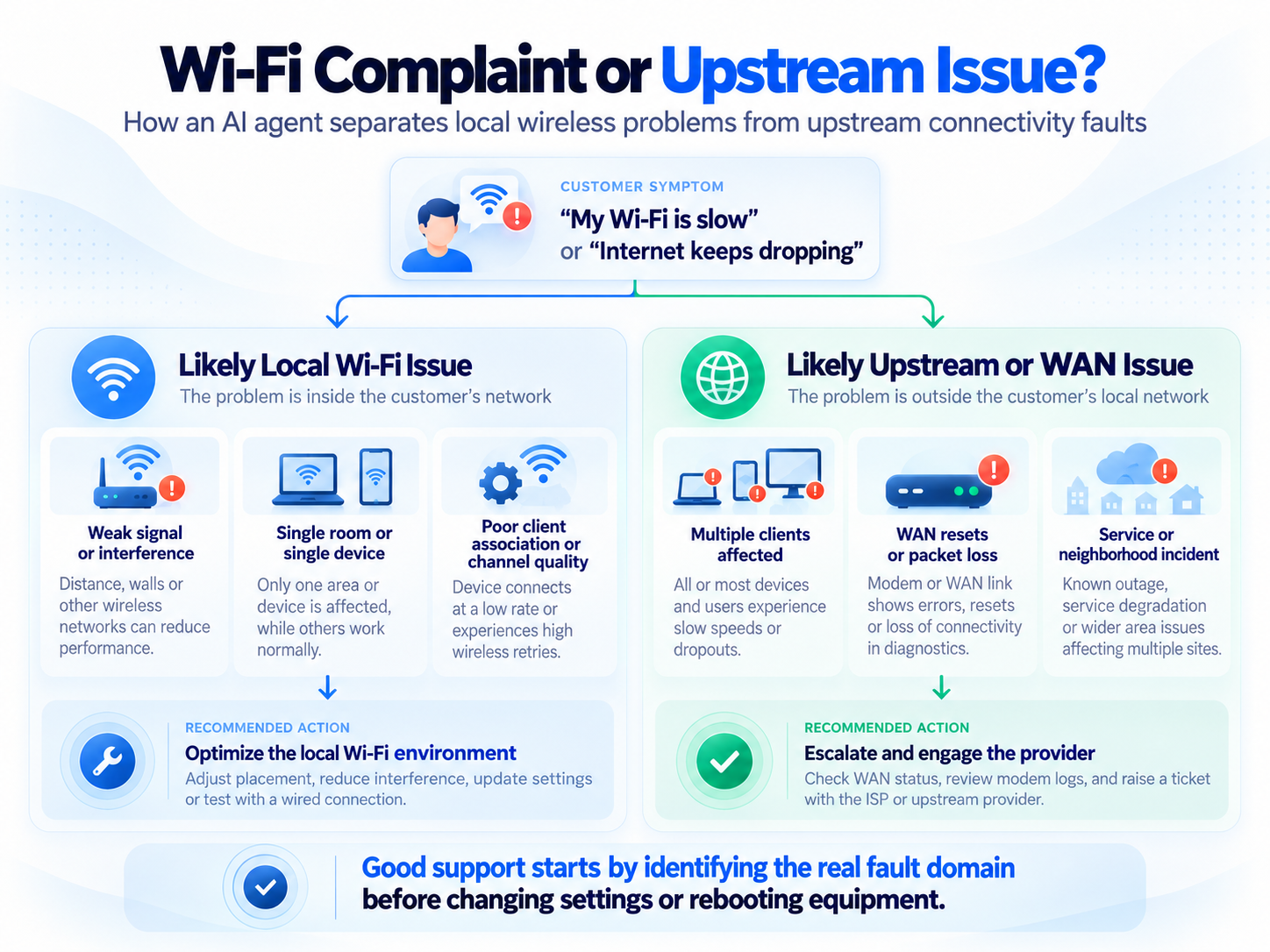
A Wi-Fi complaint is not always a Wi-Fi fault. Good support identifies the real fault domain before changing settings or rebooting equipment.
When Should the Agent Escalate to an Engineer?
The agent should not be rewarded for closing tickets it cannot substantiate. Handing a well-investigated case to an engineer can be a good result.
A human-led path is appropriate when the diagnosis remains uncertain, tools cannot provide required evidence, the change carries significant service or security impact, a physical repair is necessary, or responsibility lies with an upstream provider or another team. A repeated failed action should also trigger reassessment rather than an endless retry loop.
When escalation happens, the next engineer should receive the customer and device context, observations, checks performed, actions attempted, approvals obtained, and the reason the case was not resolved. The customer should not have to repeat the same information without good reason.
A good escalation is not a failure
The agent should package evidence, attempted actions, approvals and unresolved hypotheses so the engineer can continue from a well-investigated state instead of starting from zero.
What Does an AI Agent Need to Resolve Tickets Safely?
The technical workflow matters, but it does not need to be mysterious. Four requirements determine whether resolution can be trusted.
Operational evidence
The agent must access the relevant data in the MSP’s RMM and network systems or the ISP’s CPE, controller, and monitoring environment. Missing evidence should be reported, not guessed.
Consistent troubleshooting rules
Procedures or playbooks define what to check, what a finding means, and when the investigation must stop. Multi-customer environments may require different procedures and permitted actions for different tenants.
Authorization outside the model
Credentials, customer boundaries, approval requirements, and action restrictions should be enforced by the platform. A model deciding that an action sounds reasonable is not sufficient authorization.
Verification against the symptom
After an action, the agent should test the actual service condition – not merely whether the management command completed. Where an outcome cannot be confirmed, record that uncertainty and escalate or request confirmation.
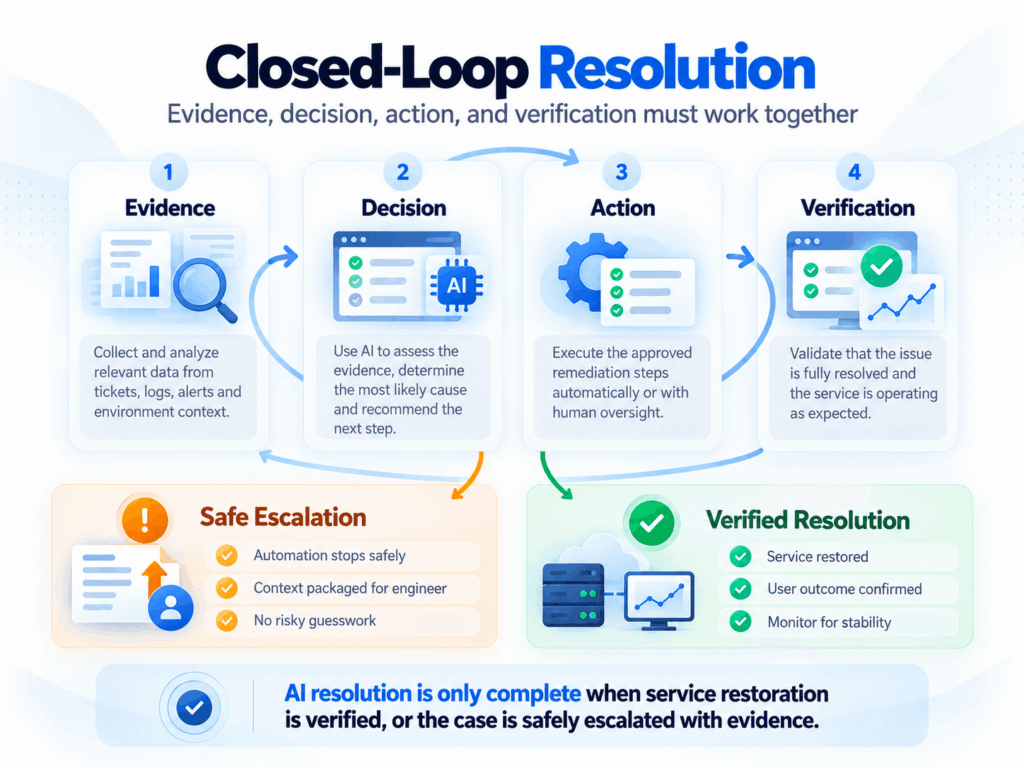
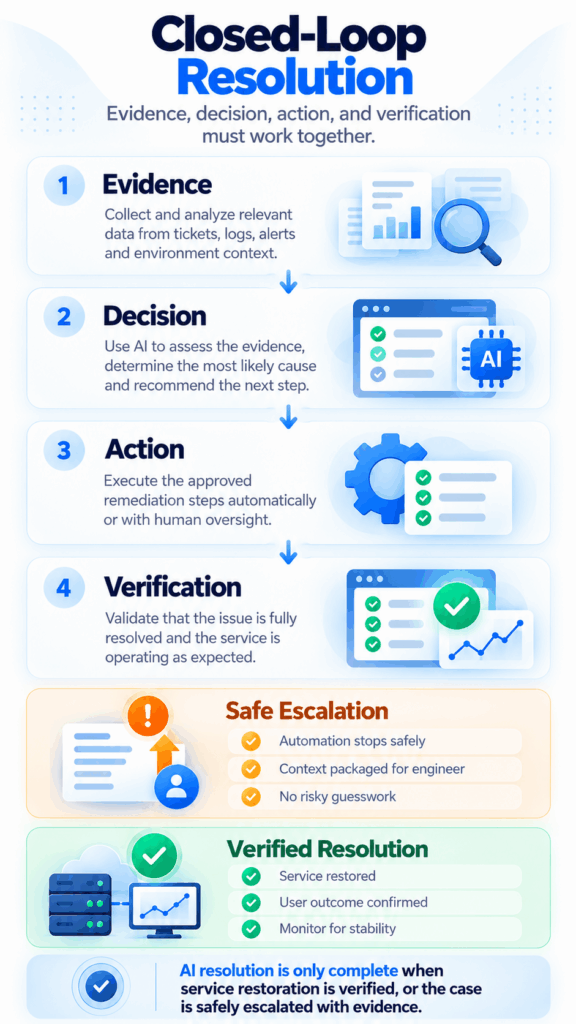
AI resolution is complete only when service restoration is verified – or the case is safely escalated with evidence.
Do MSPs and ISPs Need a New Ticketing System?
Usually not. Ticketing, PSA, and helpdesk platforms remain the record of the request, its owner, work notes, and communication. The troubleshooting agent can operate alongside them, provided the required integration exists.
It may read the ticket, associate it with the right customer and device, use permitted operational tools, and return diagnostic evidence, approval requests, and a verified outcome to the ticket. The exact depth of integration should be checked: reading tickets is not the same as updating cases or coordinating controlled remediation.
For ISPs, the same principle applies to subscriber-care systems and the network-management environment. The agent should complement the operational systems already in use rather than require the operator to replace them.
How Should MSPs and ISPs Measure Successful AI Resolution?
The headline number “tickets handled by AI” says little about customer experience. A better evaluation separates autonomous resolution from useful investigation and unsafe or incomplete outcomes.
Track:
- verified resolution rate
- engineer time spent per comparable case
- repeat customer contacts
- escalations with usable evidence
- incorrect or unauthorized action attempts
- cost per resolved ticket
- service restoration time without increased operational risk
Start with a narrow group of well-understood issues and compare the results with the existing support process. Some workflows will qualify for greater autonomy; others may deliver most of their value by reducing investigation time before an engineer takes over.
Common Questions from MSP and ISP Teams
Can AI close support tickets without human approval?
For selected low-risk, pre-authorized workflows, yes, if policy permits it and the required resolution checks pass. Sensitive, shared, or high-impact actions may require explicit approval. Ticket closure should follow the organization’s rules rather than happen automatically after a tool reports success.
Can AI resolve broadband and Wi-Fi complaints automatically?
Some recurring CPE or connectivity problems can be diagnosed and sometimes remediated through approved network-management tools. Wider outages, physical faults, unsupported devices, and uncertain cases may require escalation. A Wi-Fi complaint is not always a Wi-Fi fault.
Can AI resolve MSP tickets across different customer environments?
It can participate when tenant identity, permissions, operational integrations, and customer-specific troubleshooting rules are properly implemented. Cross-customer isolation and narrowly scoped actions are essential, not optional extras.
The Practical Answer
AI agents can resolve support tickets for MSPs and ISPs when the problem is sufficiently understood, relevant evidence is available, an authorized action exists, and recovery can be verified. They also have a useful role when those conditions are not met: reducing repetitive diagnosis and handing over a better-documented case.
The objective is not to close the maximum number of tickets without engineers. It is to restore service reliably, reduce avoidable support effort, and know when human intervention is necessary.
About Automata Flow
Automata Flow develops AI technical support agents for MSPs, ISPs, and network operations. Our agents connect ticket workflows with operational data to investigate technical issues, identify likely causes, and recommend or execute controlled actions. Human oversight, policy enforcement, and auditability remain central to how these agents operate.