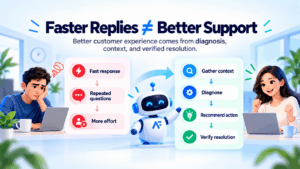
Network support teams are under constant pressure to respond faster.
Dashboards track first response time. Service levels reward quick acknowledgment. Automation helps classify, route, and assign tickets within seconds.
These improvements matter.
But a faster response does not automatically create a better customer experience.
A subscriber whose connectivity problem receives an immediate acknowledgment but takes hours, multiple conversations, and repeated troubleshooting steps to resolve may still consider the support experience poor.
The real question is not simply: How quickly did we respond? It is: How quickly did we understand the problem, take the right action, and restore the customer’s service?
For network support organizations, this distinction is becoming increasingly important.
Fast Response Is Only the Beginning
Traditional support metrics often emphasize how quickly a ticket moves through the support process.
A support team may measure:
- first response time
- ticket acknowledgment time
- assignment time
- queue wait time
- escalation time
These metrics are useful because long periods of silence create frustration. But they primarily measure how quickly the support organization reacts. They do not necessarily measure whether the problem is being solved.
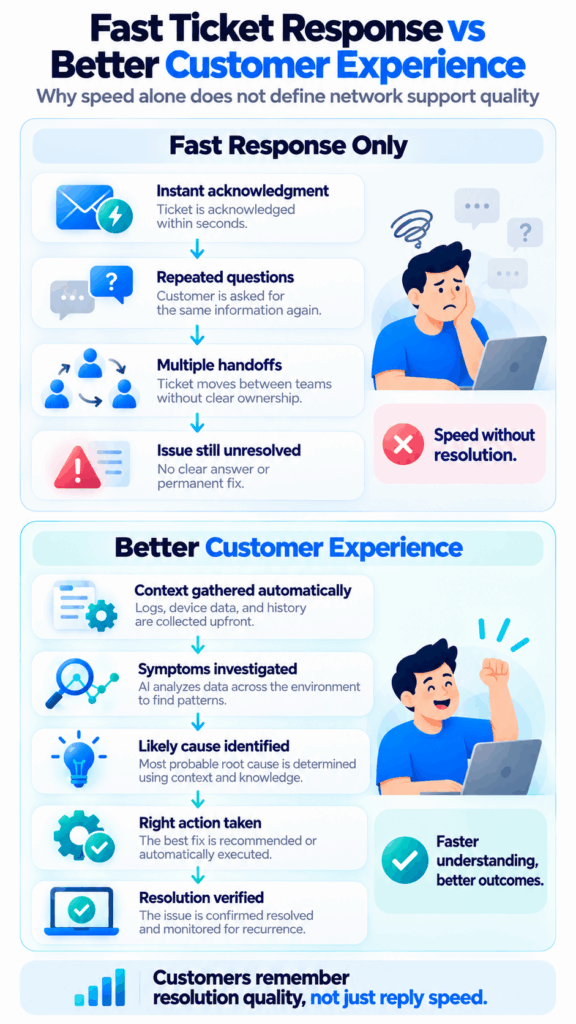
Consider two support experiences.
Experience A
A customer reports intermittent Wi-Fi connectivity. Within one minute, the customer receives an acknowledgment that the request has been received and an agent will assist shortly. The ticket is routed immediately. But the customer then repeats the problem to multiple agents, performs the same troubleshooting steps several times, and waits hours for resolution.
Experience B
The customer waits slightly longer for the first response. But during that time, the support system has already collected device status, Wi-Fi telemetry, recent configuration changes, and service information. The first meaningful response explains that repeated disconnects are visible on the affected device while the gateway and other clients remain stable, and that the issue is being investigated as a client-specific connectivity problem.
The second experience may have a slower initial acknowledgment, but it can feel dramatically better to the customer. The difference is useful progress.
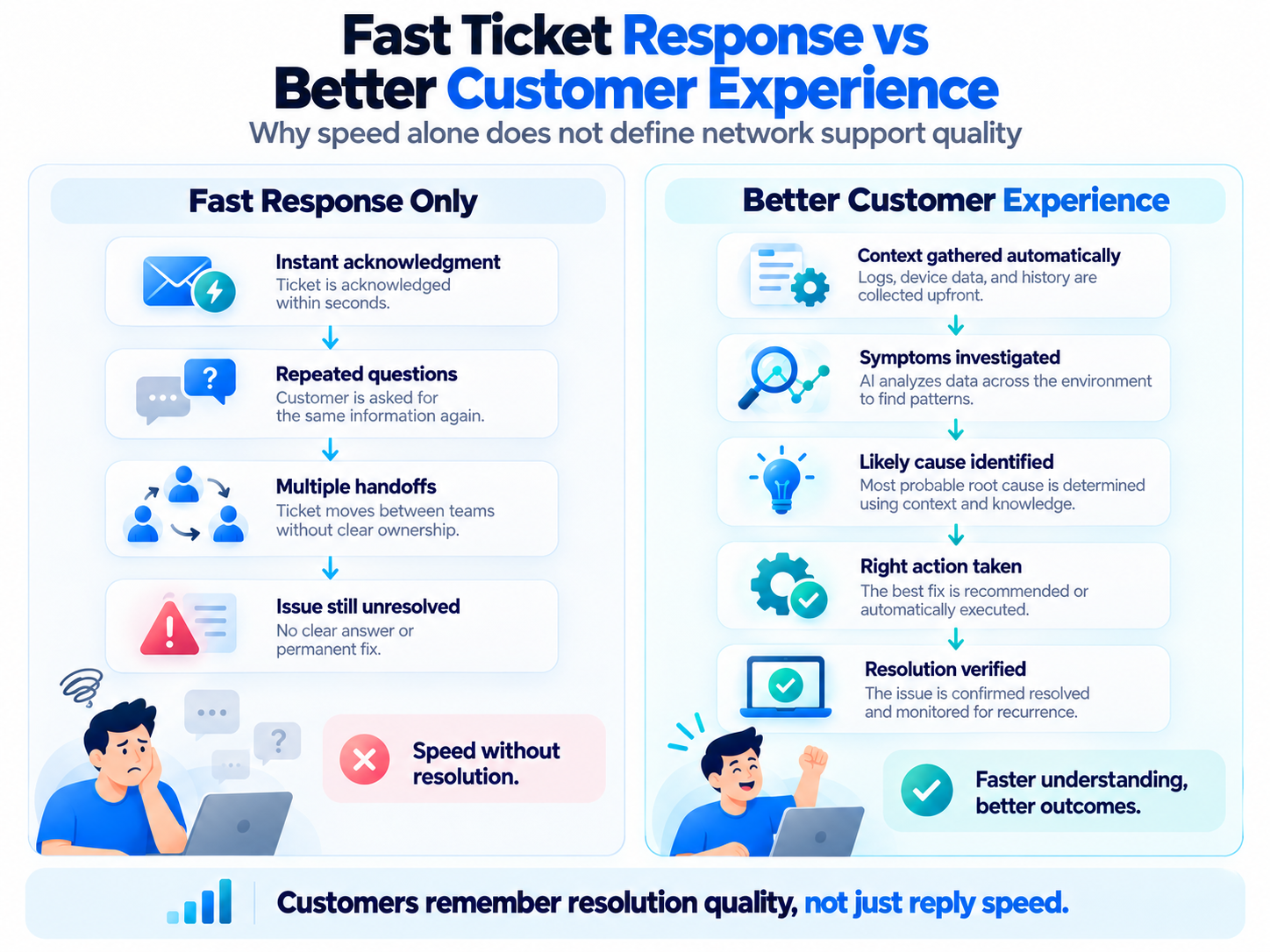
Customers Experience the Entire Resolution Journey
Customers rarely evaluate support based on a single timestamp. They experience the complete journey.
- Reporting the problem
- Explaining what happened
- Waiting for investigation
- Performing troubleshooting
- Repeating information after escalation
- Waiting for another team
- Testing whether the issue is resolved
- Contacting support again if the problem returns
A very fast first response can therefore coexist with a frustrating support experience. The customer may still encounter repeated questions, unnecessary troubleshooting, multiple transfers, inconsistent explanations, long resolution times, temporary fixes, and repeated incidents.
Optimizing only the beginning of the journey can create the appearance of speed without improving the outcome.
The Difference Between Response Time and Resolution Time
Response time measures how quickly support reacts. Resolution time measures how quickly the underlying problem is actually addressed. Both matter, but they answer very different questions.
A ticket can have an excellent first response time and still require hours or days to resolve. This is especially common in network support because the first symptom reported by the customer may not reveal the real cause.
A customer may say: “My internet is slow.”
But the actual cause could involve:
- poor Wi-Fi signal
- radio interference
- overloaded channels
- client-specific behavior
- gateway instability
- incorrect configuration
- WAN degradation
- upstream network problems
- firmware defects
- a broader service incident
Responding immediately does not remove the need to investigate. The quality of the experience depends on how efficiently support moves from symptom to cause to resolution.
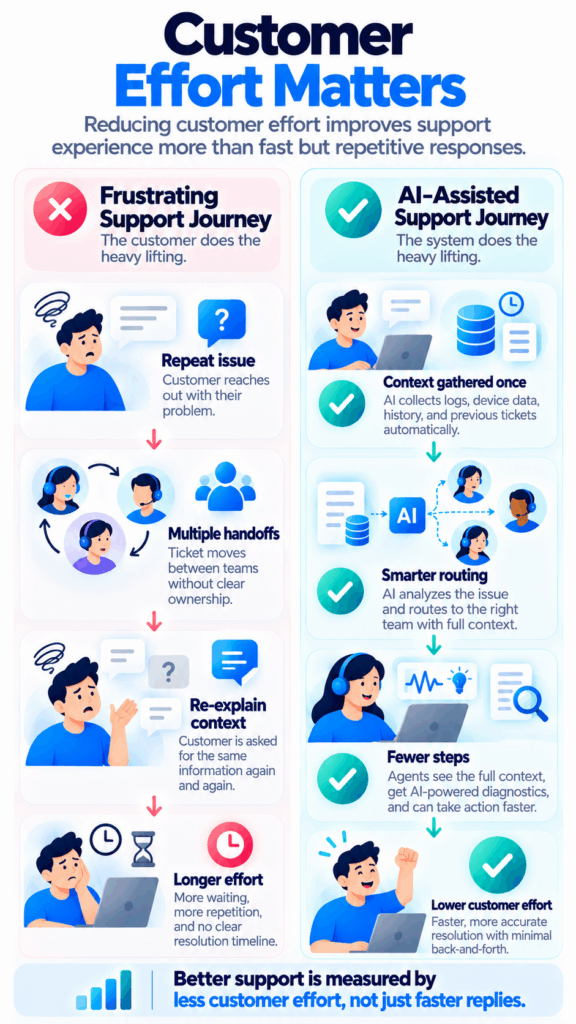
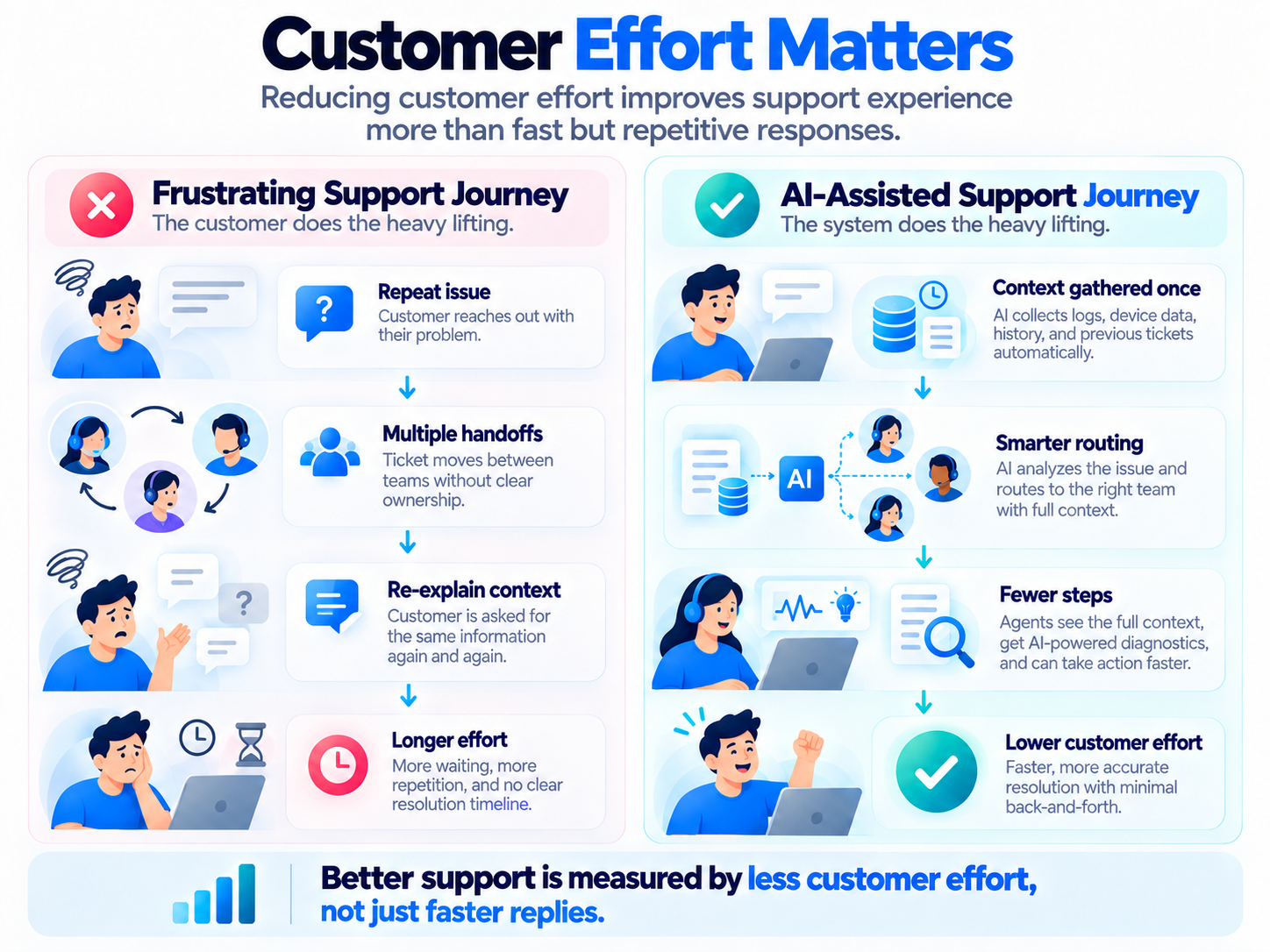
Customer Effort Matters
Another important factor is how much work the customer has to perform during the support interaction.
Customers become frustrated when they repeatedly have to:
- explain the same issue
- provide device information already available to the operator
- restart equipment without understanding why
- repeat troubleshooting after escalation
- switch between chat, phone, and email
- wait while agents manually check different systems
A support process can technically be fast while still demanding significant customer effort.
For example, automatically responding within seconds and then asking for router model, software version, connected device, and current network status may not feel intelligent if the operator’s systems already contain that information.
A better support workflow should reduce the amount of information the customer needs to provide manually.
Why Network Support Is Different
Network support is particularly sensitive to this problem because diagnosis usually requires operational context.
The support team may need information from:
- subscriber systems
- network controllers
- CPE or gateway management
- Wi-Fi telemetry
- topology
- alarms
- monitoring platforms
- configuration history
- firmware systems
- previous support interactions
When these systems are disconnected, the support agent spends time assembling context manually. The customer experiences that delay as “Please wait while I check,” “Let me transfer you,” “Can you repeat what happened?” or “Please perform these troubleshooting steps again.”
The issue is therefore not always the speed of the support agent. It can be the speed at which the organization can assemble operational context.
Context Before Conversation
One way to improve customer experience is to gather relevant operational information before asking the customer additional questions.
Suppose a subscriber reports: “My Wi-Fi keeps dropping.” Before the support interaction progresses, an intelligent workflow could check:
- Is the gateway online?
- Has it recently rebooted?
- Are both Wi-Fi radios operational?
- Are all devices affected?
- Is only one client disconnecting?
- Has signal quality changed?
- Are there repeated authentication failures?
- Is WAN connectivity stable?
- Were configuration changes made recently?
- Are similar incidents occurring nearby?
This changes the conversation. Instead of beginning with generic troubleshooting, support can begin with evidence. The customer spends less time explaining what the network already knows.
First Contact Resolution Is More Valuable Than Fast Acknowledgment
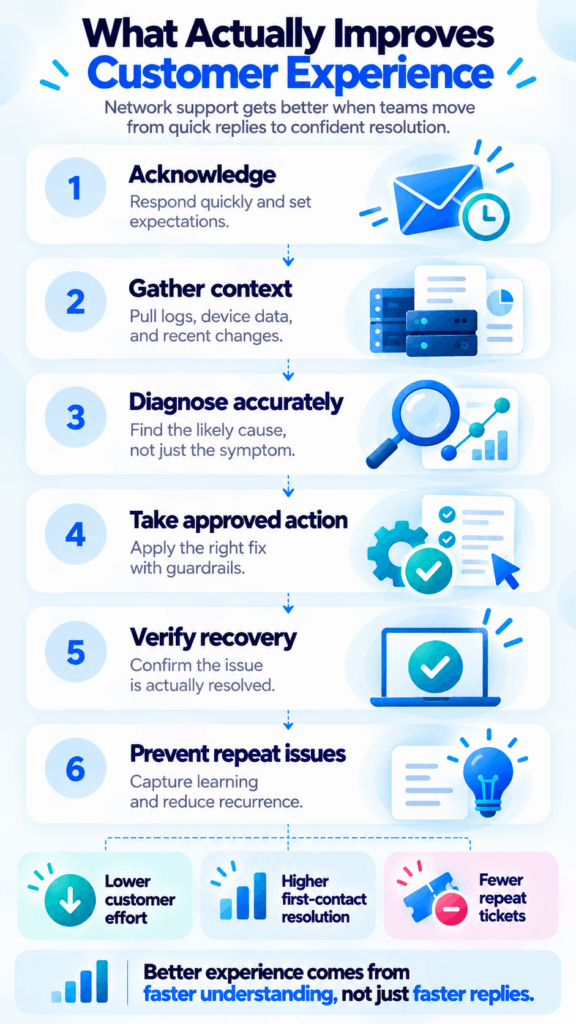
A customer usually prefers one effective interaction over several fast but incomplete interactions. This is why first contact resolution can be more meaningful than first response time when evaluating customer experience.
Scenario 1: Fast response, repeated contacts
- Ticket acknowledged in 30 seconds
- Basic troubleshooting performed
- Issue temporarily disappears
- Customer reconnects later
- Ticket is reopened
- Another agent repeats the investigation
Scenario 2: Slightly slower response, complete investigation
- Operational context is collected automatically
- Likely root cause is identified
- Appropriate action is taken
- Service recovery is verified
- Customer does not need to contact support again
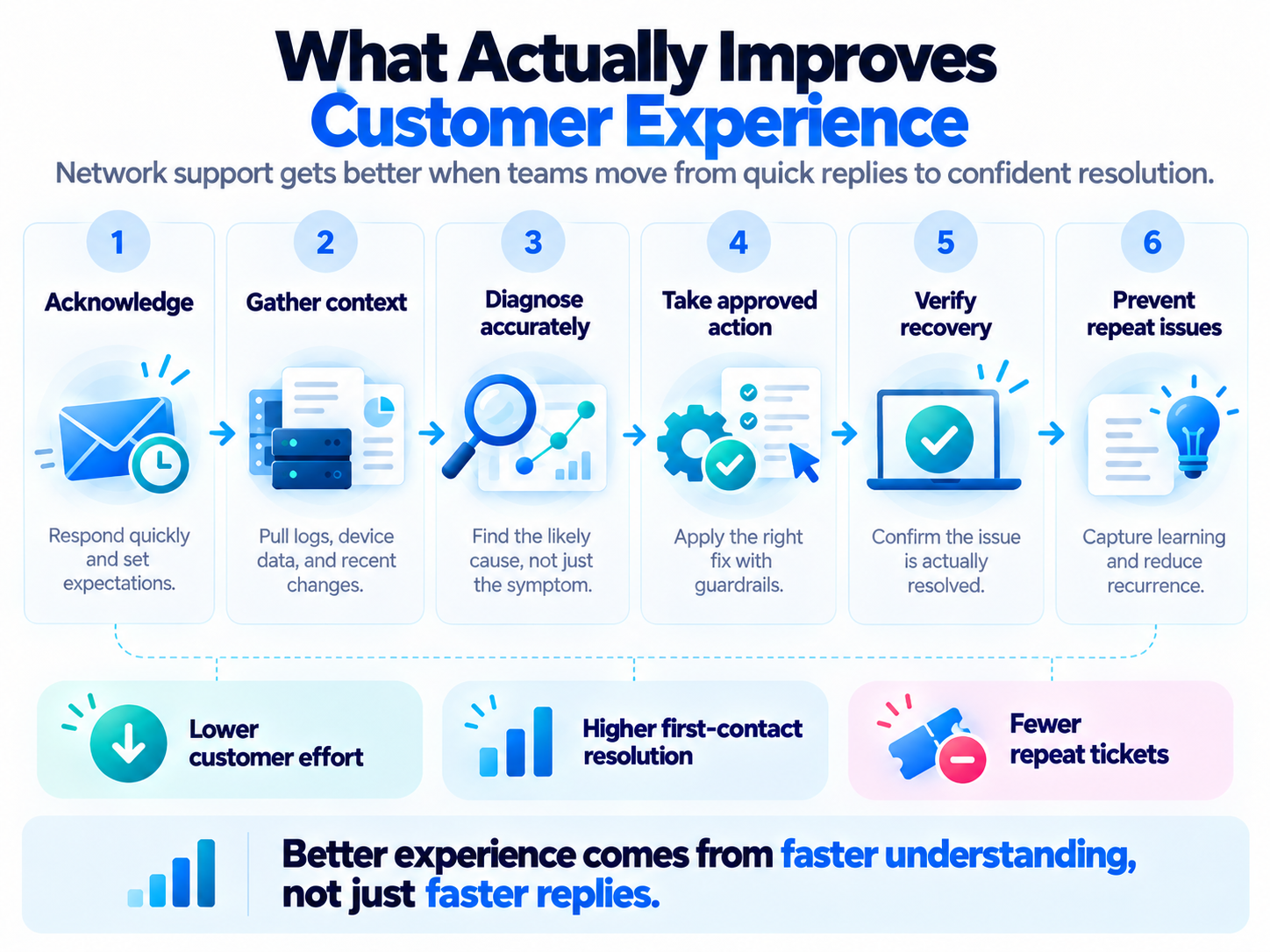
The second scenario may produce a better customer experience even if the first acknowledgment takes slightly longer. The meaningful metric is not simply how quickly support began. It is how effectively support ended.
Resolution Quality Matters Too
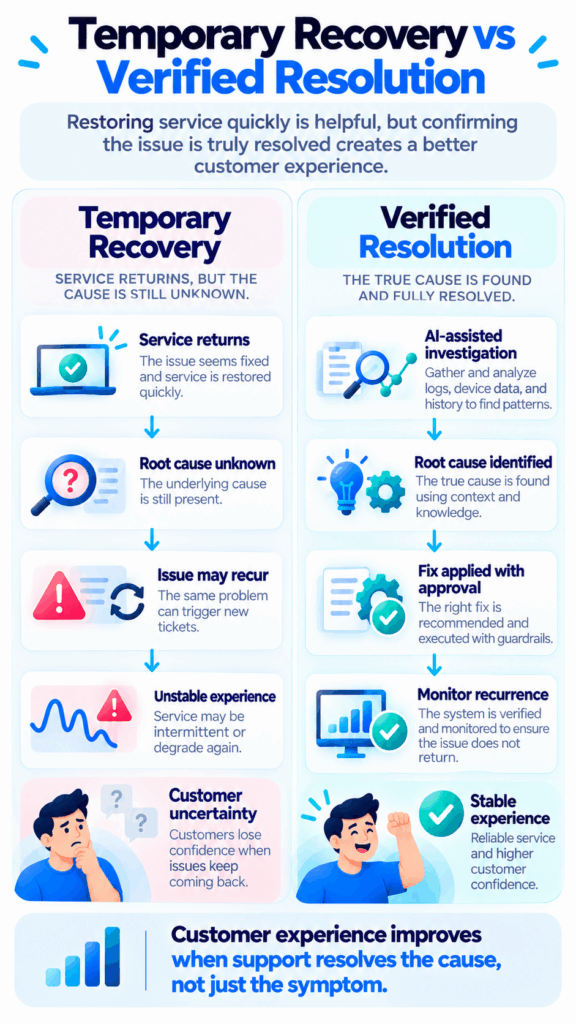
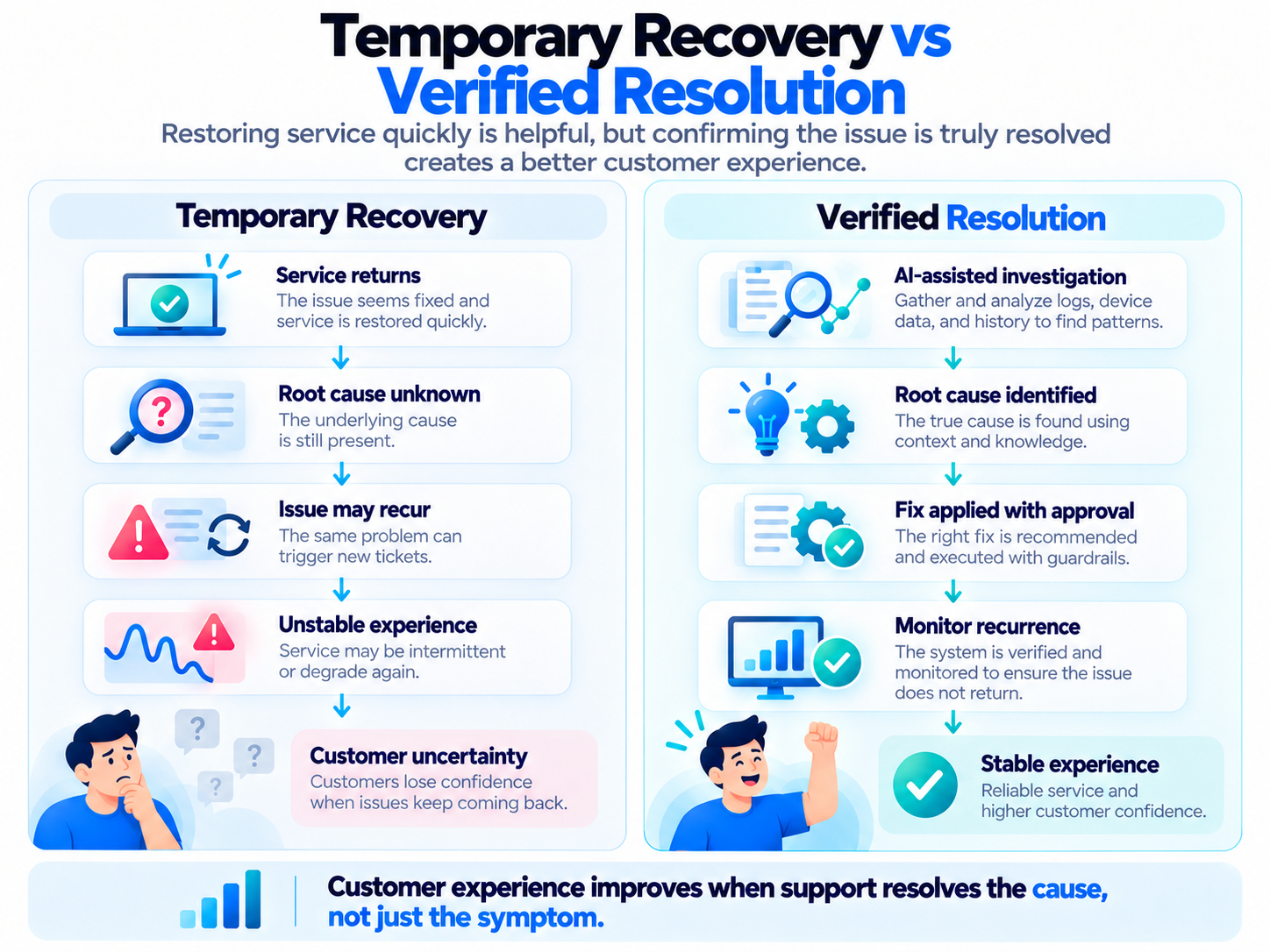
Even fast resolution is not enough if the same problem returns. Network support should therefore distinguish between temporary recovery and verified resolution.
A gateway reboot may restore service. But if the underlying reason for repeated gateway failures remains unknown, the customer may experience the same problem again tomorrow.
Closing the ticket immediately after connectivity returns can improve resolution metrics while creating a poor long-term experience.
A stronger workflow asks:
- Did service recover?
- Did the original symptom disappear?
- Is the system stable?
- Is the issue likely to recur?
- Should the incident remain under observation?
- Is additional remediation required?
Verification should be part of resolution.
What AI Agents Can Change
AI agents can help network support teams optimize for more than ticket speed. Instead of simply acknowledging and routing a ticket, an agent can participate in the investigation itself.
An AI agent could:
- collect subscriber and device context
- query network controllers
- inspect telemetry
- review recent configuration changes
- correlate symptoms across systems
- compare the incident with known patterns
- identify likely causes
- recommend next actions
- execute approved low-risk remediation
- verify whether service recovered
- prepare an informed escalation when human expertise is needed
The objective is no longer only “Respond faster.” It becomes “Make useful progress sooner.
Faster Support Should Mean Faster Understanding
A support organization can reduce first response time by automatically sending acknowledgments. But reducing the time required to understand the problem requires something different.
It requires:
- access to operational context
- integration across systems
- domain knowledge
- diagnostic workflows
- historical information
- policy-controlled actions
These capabilities allow support automation to move deeper into the resolution process. The result is not simply faster communication. It is faster understanding.
When Human Support Is Still Needed
Not every network issue should be resolved automatically. Some incidents involve uncertain root causes, unusual device behavior, broad service impact, high-risk configuration changes, complex infrastructure dependencies, or situations requiring engineering judgment.
In these cases, the goal should not be to eliminate the human engineer. The goal should be to make escalation more useful.
Instead of handing an engineer a ticket containing “Customer reports unstable Wi-Fi,” an AI-assisted workflow could provide:
Gateway has remained online for 48 hours. WAN connectivity is stable. One 5 GHz client shows repeated disconnects while five other clients remain stable. Signal strength on the affected client has degraded during each event. No configuration changes were detected. No remediation has been executed.
The engineer begins with context rather than starting the investigation from zero. That improves both engineer productivity and customer experience.
Measure Progress, Not Just Activity
Support organizations should still measure response time. But it should be considered alongside metrics that better reflect the customer journey.
Useful measures may include:
- time to meaningful diagnosis
- time to resolution
- first contact resolution
- repeat contact rate
- escalation rate
- number of transfers
- customer effort
- recurrence after resolution
- percentage of issues resolved without manual intervention
Together, these metrics provide a more complete view of support performance. A fast acknowledgment is valuable. A fast and accurate resolution is much more valuable.
From Faster Responses to Better Outcomes
Network support should not become slower. The goal is not to choose between speed and quality. The goal is to define speed differently.
Instead of optimizing only for “How quickly did we answer the ticket?”, support teams should also ask:
- How quickly did we understand what was happening?
- How quickly did we identify the right action?
- How quickly did the customer return to normal service?
- Did the problem stay resolved?
That is the difference between optimizing ticket handling and improving the actual customer experience.
As network operations become increasingly automated, the most valuable AI systems will not simply respond faster. They will help support teams understand faster, resolve more accurately, reduce customer effort, and verify that the problem is actually fixed.